
It’s hard to believe that we have been gone 5 weeks already. It seems like we just left LAX, but at the same time, we have so many incredible experiences. I feel like we are on the family version of that CBS TV show The Amazing Race. We have already taken 15 flights and put our heads down on 13 different pillows — some soft and some hard. Packing and unpacking is something that we can now practically do in our sleep.
We are doing a sort of “Taste of the World” —a type of festival where you get to sample small portions of the best restaurants in a particular city. We are sampling some wonderful “bites” of the world, which is great, but leaves you wanting more. The list of places we want to spend more time in is growing with each new place we visit. We just finished up three “bucket list” or “once in a lifetime” trips back to back to back: Galapagos, the Amazon, and Machu Picchu. All were completely different, but wonderful in their own way.
The Galapagos Islands were nothing like I had imagined. I pictured lush, tropical islands with a rainforest type of landscape and warm water. But they were nothing like that. The Islands we visited were stark and dry with very little vegetation. Even though the Islands are located on the Equator, the water temperature was only 67 degrees. This is due to the strong Humbolt current which brings cold water from the South. This current is what brought the penguins to the Islands as well. Our expedition was lead by a team of extremely knowledgable naturalists. Their lectures coupled with our sea and land based excursions gave us tremendous insights into the geology and biodiversity of the Islands. The Galapagos are a kind of upside down world. You might see a penguin resting under a cactus and a night owl that hunts in the day. The Islands are a lot like the Big Island of Hawaii only there are no carnivores on the islands. The creatures that live on the Islands do not have many natural predators and, therefore, their behaviors are much different than anywhere else in the world.


We really enjoyed time on the Yacht La Pinta in the Galapagos as there is something special about being gently rocked to sleep by the swells of the ocean. This makes me excited about spending 4 months on Semester at Sea during the second half of our adventure.
We flew from the Galapagos to Guayaquil, Equador to Lima, Peru where had time for a shower and a few hours of sleep at the hotel located across from the airport. Our 3.00 AM wake-up call was brutal but necessary to make our 5.20 AM flight to Iquitos — the gateway to the origin of the Amazon. I always thought the Amazon River was only within Brazil, but it starts in Peru and winds it way to Brazil with tributaries from Colombia, Venezuela, Guyana, and Bolivia.
The Amazon River originally flowed from East to West which essentially split the continent into two parts. When the Andes rose from the Pacific Ocean, the river was cut off from the Pacific. The River eventually pooled up against the Andes in Peru and began to flow backwards trapping numerous salt water animals. That is why the Amazon river has dolphins, string rays, electric eels and manatees. We were lucky enough to see several pods of pink dolphins which were quite a sight. The reason the dolphins are pink is because their capillaries are located just under their skin.
We had a great stay on the Aria which holds 30 passengers and is part of the Aqua Expeditions fleet. (We were originally scheduled to sail on the Aqua Amazon but, unfortunately, two weeks before our trip, it exploded and sank during routine maintenance and refueling.) On the Aria, our family had our own naturalist and skiff which we took on our daily excursions. We also had some informative presentations on the ecology and wildlife each evening. We were on the River during the dry season which worked out great as we didn’t get rained on, the mosquitoes were hard to find, and the weather was humid but not hot with a high of 75 degrees. We were fortunate to see almost everything the River and region has to offer. During a jungle walk we saw a huge tarantula, bats, a tiny orange frog that is extremely venomous, a huge rainbow boa, a three toed sloth, and lots of monkeys. On the water, we saw pods of pink and bottle nose dolphins, we caught baby caimans during a night skiff cruise, we caught piranha, swam with piranha and finally ate piranha. We also enjoyed a visit to a riverside village where we canoed with local kids and then swam with them and all of the creatures in the River.
Flying over the Amazon at sunset I was overwhelmed by the massiveness of the amazon region which was only matched by my feelings of gratitude at the opportunity I have to take this trip with my family.


We flew back to Lima from Iquitos where we a had a day to see the city before we left for Cusco, Sacred Valley and Machu Picchu. We spent the day in Lima with a chef, Marisol, who took us the Lima market where we sampled typical Peruvian fresh fruit and saw how the locals buy their cooking supplies. We then had a feast at the hot new restaurant, La Picanteria, owned by famous chef Hector Solis, where locals wait for up to 2 hours to get a seat. After a delicious meal, we headed back to hotel where we all crashed for a couple hours before doing some work, homework and laundry.
We had another early wake up call, 5.00 AM, in order to catch our flight to Cusco. Cusco was the capital of the Inca Empire and is located at an elevation of 11,500 feet. We all made an effort to drink lots of water and to suck on Coca candy, but the elevation caught up with the men. Nico was the first to get a really bad headache followed by Luke and then at dinner I felt horrible. Fortunately all of the symptoms of elevation sickness passed by the time we woke up the following morning. We jumped in our van and headed to the Sacred Valley with our guide, Edgar. Edgar was a proud Quechua/Inca from a small village in the highlands and has trekked the 5 night Inca Trail over 850 times. We were in good hands.
We spend the first two days in the Sacred Valley where we got to experience the beauty of both the people and land. We visited the salt mines where we learned that the Incas were able to mine salt by creating an elaborate terraced network of salt pools. In the 1600’s salt was considered as valuable as gold by many and these salt flats were of huge importance to the Spanish. We also visited the the circular terraces of Moray which functioned as a research laboratory for the Incas. The Incas studied temperature variations from one terrace to another in order to develop different crop varietals. Once they analyzed which crops grew the best at different levels they would distribute the seeds throughout the Inca Empire.
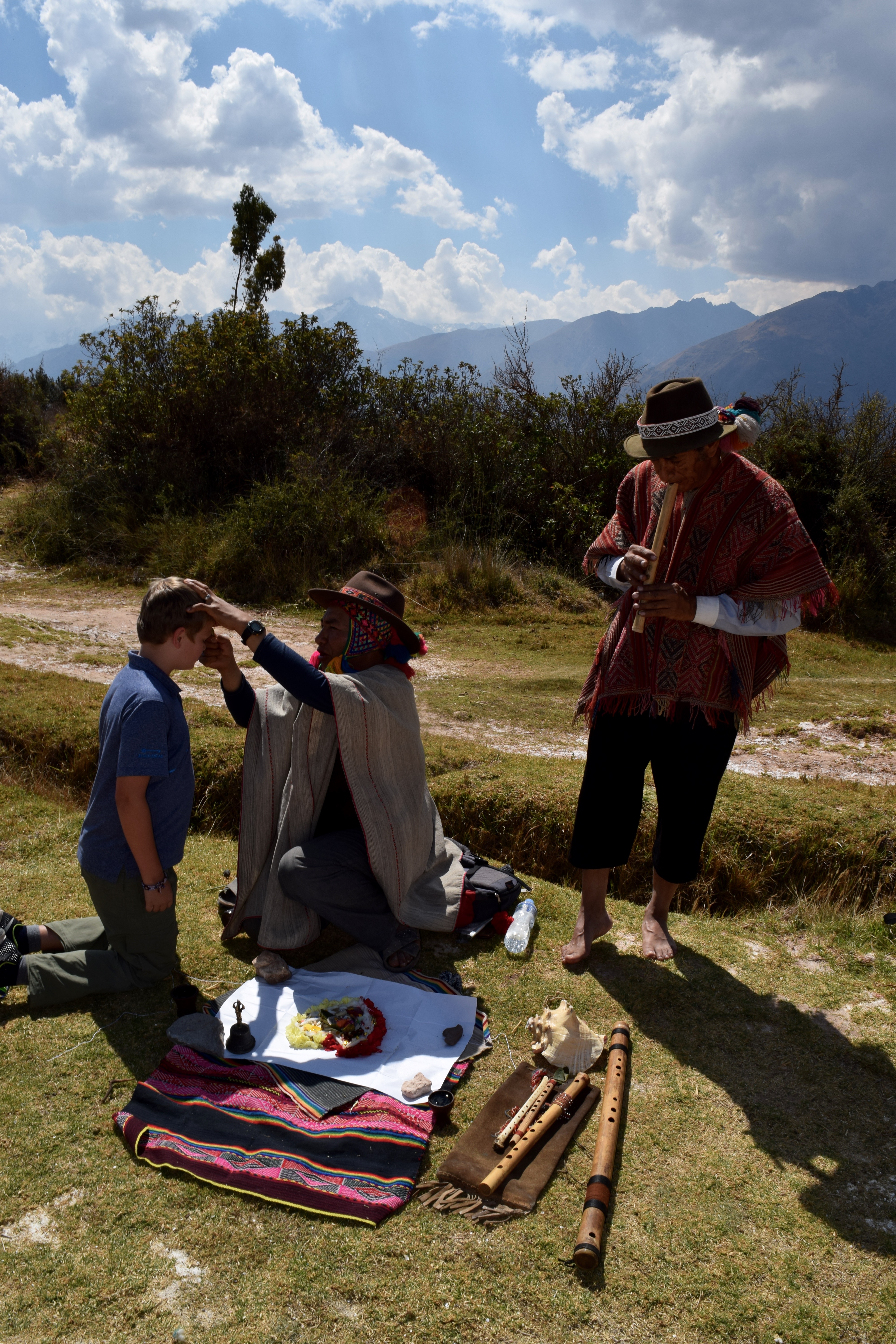
After these two stops, we were treated to one of the most spiritually impactful events of my life. We had the opportunity to have a session with a shaman from a local tribe. We participated in a service dedicated to Pacha Mama, Mother Earth, as well as a family blessing for our safe travels. It was a beautiful ceremony which included live music played on traditional Incan instruments by a local bare-foot Peruvian. Our guide acted as translator as the shaman spoke in his native language. I wasn’t prepared for the flood of emotions that came to me, but I couldn’t hold back and I started to cry. Earlier that morning on the balcony of our room which overlooked the beautiful Urubamba River and the snow capped Urubabmba mountains, I had an amazing meditation session where I felt completely content. I do not recall ever feeling that way in my life. It was a powerful feeling of oneness with the universe, which sounds corny but is true. When the shaman started his ceremony, he referred to the power of Pacha Mama and her presence when we meditate. For me, this triggered a flood of emotions. He asked us to say a prayer and then blow on the coca leaves. He prepared an offering which would include our wishes as well as many sacred medicines like Palo Santo, Tayta Sayri, Agua Florida, Condor’s feathers, “Grandfather Puma,” as well as several incenses. He asked us to mediate at 8:00 pm at which time he would present this offering to Macha Picchu in a fire back at his village. Our family gathered at 8:00 and we all wrote our prayers on a piece of paper and then burned our prayers into the fireplace to unite with offering from the shaman. I thought about how grateful I am for this opportunity as well as for my mom. She is not doing well, but I felt a sense of peace that my mom would be able to find the same in her new reality.
After the ceremony, we had lunch which included guinea pig, at the home of a local villager. We saw how they made their clothing and learned that the Incas did not have system of writing. The patterns in the materials were used a communication tool as they all told stories and had significance to the villagers.
The following morning we boarded the 6:00 am train to the Inca Trail. The full trek is a 5 day and 4 night journey. Instead of that, we opted for the 8 mile, 6+ hour trek to the Sun Gate and Machu Picchu. It was a beautiful trek that included some intense uphills as well as tight passages. About one third of the way through, Nico was not doing well. He said, “I can’t make it, dad.” Reese and Luke started on him. I pulled Reese and Luke aside and informed them we were a team and a team is only as strong as its weakest link so we better support Nico. Reese said something like, “Oh great, we are screwed.” I then had a talk with Nico in which I told him that I knew he could do it. We wouldn’t have put him in this position if we didn’t think he could make it. I also told him that we couldn’t go back, so we better plow ahead. With the encouragement from Reese and Luke, Nico decided to powered on. Nico found that telling stories on the trail helped distract him so he proceeded to tell about the two books he has read recently — James and the Giant Peach and Where the Red Fern Grows. I was really proud of our entire family, especially Nico, for making it to the Sun Gate and on through to Machu Picchu. The trek was a hard, 6+ hours, but the view and feeling of team accomplishment was worth it.
After a jacuzzi and room service in our hotel we all slept well. We had another early wake-up call for our 5:00 am breakfast before catching the bus back into Machu Picchu. That morning, Edgar taught us about the Inca Empire and the lost city of Machu Picchu. Due to its remoteness and difficulty in reaching it, the Spanish were never able to locate and destroy this amazing city. There are many theories as to why Machu Picchu was deserted before being completed — disease, fear of the Spanish, or rebellion within the Empire. One thing is for certain, the architectural skills as well as the construction management necessary to build a fortress of this magnitude on the side of a mountain is awe inspiring. The University of Wisconsin recently concluded that the aqueduct system installed at Machu Picchu was 500 years more advanced than anything else in the world at the time of construction. The Incas were also amazing astrologists. On the summer solstice the sun rises directly between the two doors of the Sun Gate and then shines threw on a small window in the Sun Temple.
After our educational tour, we lined up to climb Huayna Picchu (which means “small mountain”). Huayna Picchu is the mountain just behind Machu Picchu and was also an important temple for the Incas. Huanya Picchu only allows 200 people at a time on the mountain due to its narrow paths and steep trails. Although it is only a 2+ hour hike, the difficultly level is high. Struggling up the trail with nothing but our own body weight, it was hard to imagine the Incas ascending the steep stairs with large pieces of stone on their backs. But despite the difficult ascent, the view at the top was well worth it. We ended the day with a 4 hour train ride back to Cusco. We were all very tired but we felt great about what we experienced in the Sacred Valley and Machu Picchu.

That night in Cusco, we held a “family meeting” where we went around the table and each of us expressed how we were feeling about the trip. Everyone had an opportunity to provide positive feedback as well as constructive criticism. It was great to see how the kids are bonding. Thankfully, the combination of having no other friends around, the forced closeness of having every meal together and sharing the same room, and basically spending 24 hours a day together is having a positive impact on their relationship (despite the typical intermittent sibling bickering). The next evening we were in the Lima airport waiting for our red eye and we noticed that the flight at the gate next to us was leaving for Los Angeles. I asked, “who wants to go LA?” and they in unison said, “No way!!” I guess we are plowing ahead.
This is beautiful, Greg. I learned so much. I just know you will get to BKK and be teaching me about the city I’ve lived in for two years! Can’t wait to see you guys. Go Chapmans! Xoxo
Greg,
What a great blog with such insight. This is truly a life changing experience for all of my family. I especially appreciate your comments on your feelings of peacefulness and fulfillment and spiritual growth. It is such a blessing to keep up with the whole family in reading your comments.
Luv ya,
Pops
Greg, this is an awesome recap of your Galapagos, Macu Picchu and Amazon adventures and experiences. Thanks so much for sharing so much with us. So happy the family is bonding and having such a great time. Prayers for your mom, I think of her often. Know she is in all our thoughts and prayers. Have fun, continue to travel safely and write often.
Dear Greg, From the challenges to the blessings, I loved every step you shared and every word of your thoughtful post. Go Team Chapman!!!
Thank you for sharing not only the awesome adventures of Team Chapman but also the beautiful insight into your feelings of peace and spiritual growth. I shed a few tears as I read your comments! God’s blessings to each of you
YOU GO CHAPPY’S!!!
living the dream for sure:)
GC,
Thank you for the detailed posting. What an amazing adventure! Wow!!! I look forward to reading about the abundance of life-changing memories yet to come.
PS – I like the beard!