
Hello New Zealand!
After spending our first 60+ days in Central and South America where my Spanish/spanglish was put to the test, it was great to be in a country where English is the first language, you can drink the tap water and you can flush the toilet paper.
New Zealand is an amazing country made up of 4.5 million residents which is less than half the population of Los Angeles County. Over 20% of the population was born outside of New Zealand which explains how welcoming they are of foreigners. Due to our travel schedule, our itinerary was limited to the North Island and we were not able to visit the South Island. Everyone I spoke with said that it is a must see so we will definitely plan a return visit which will include a stop to the South Island.
We spent a very active week on the North Island of New Zealand. After leaving Patagonia Friday morning, we arrived into Auckland early Sunday morning. What happened to Saturday? (5 hour van ride from Torres del Paine to Punta Arenas, 3 hours in Punta Arenas airport, 4 hour flight to Santiago, 4 hour layover and then a 14 hour flight in additional to crossing the International Dateline). I’m tired just typing that.
New Zealand was formed between 80 and 100 million years ago when it broke away from Gondwanaland (Antarctica and Australia) and started to move toward its present position. The Tasmanian Sea was formed, and since that time New Zealand has had its own geological history and developed a unique flora and fauna.
Our first day was spent exploring Auckland which is the largest city and has a population of 1.4 million. We visited the War Memorial Museum where we were able to take in an exhibition and performance of the Maori. New Zealand’s first settlers were Polynesian and developed their own unique Maori culture. When these first settlers came to New Zealand, around 1250, they found an abundant food supply. New Zealand had no warm blooded mammals before people introduced them so multiple species of birds lost the trait of flight as it wasn’t necessary for survival. The national bird and common nickname for New Zealanders is Kiwi. Maori hunted kiwi for meat, skin and feathers, using dogs/kuri and traps, but did so sparingly and with great ceremony – special chants and rituals took place before a kiwi hunt began.

Captain James Cook was the first explorer to map and circumnavigate the Islands in 1769 on the first of his three voyages to New Zealand. From the late 18th century, the country was regularly visited by explorers and other sailors, missionaries, traders and adventurers. In 1840 the Treaty of Waitangi was signed between the British Crown and various Maori chiefs, bringing New Zealand into the British Empire and giving Maori “equal rights” with British citizens.
New Zealand is a very progressive country. They were the first country to allow women the right to vote as well as establish a type of social security system for retirees. The relationship between the Maori and the Europeans was and still is pretty good. The Maori were not forcibly removed from their land like our Native American Indians or aboriginals in Australia. The Europeans have embraced the Maori culture in a number of ways. The most visible is the Haka dance which is performed by the All Black’s, New Zealand’s rugby team – currently the #1 team in the World, before their matches. Check out this video, https://www.youtube.com/watch?v=ewz__XYclnw
After exploring Auckland and learning about the history and culture of New Zealand we headed South to Rotorua. After getting out of the city, adapting to driving on the other side of the road was fairly easy. The four hour drive was scenic as we passed numerous small sheep and dairy farms. Rotorua is known for its geothermal activity and adventure sports. We explored a number of their parks similar to Yellowstone and Old Faithful, and took part in a number of adventure sports.


We started one of our days in Rotorua by visiting an adventure park which had bungy jumping, swoop, free fall and Zorb’ing. I was really proud that both Reese and Luke did their first bungy jump. Nico was disappointed that he couldn’t bungy as 10 was the minimum age to jump. We all did swoop which requires you to crawl into a sleeping bag like contraption which is connected to two other similar bags all of which are connected to long rope. You are then lifted 143 ft. into the air by a crane — sounds like fun! When you reach the top a guy below yells, “pull the cord!” and one of the three pulls the ripcord and you free fall. Check out Nico’s face after he pulls the cord, classic. Even better watch Nico the second time around
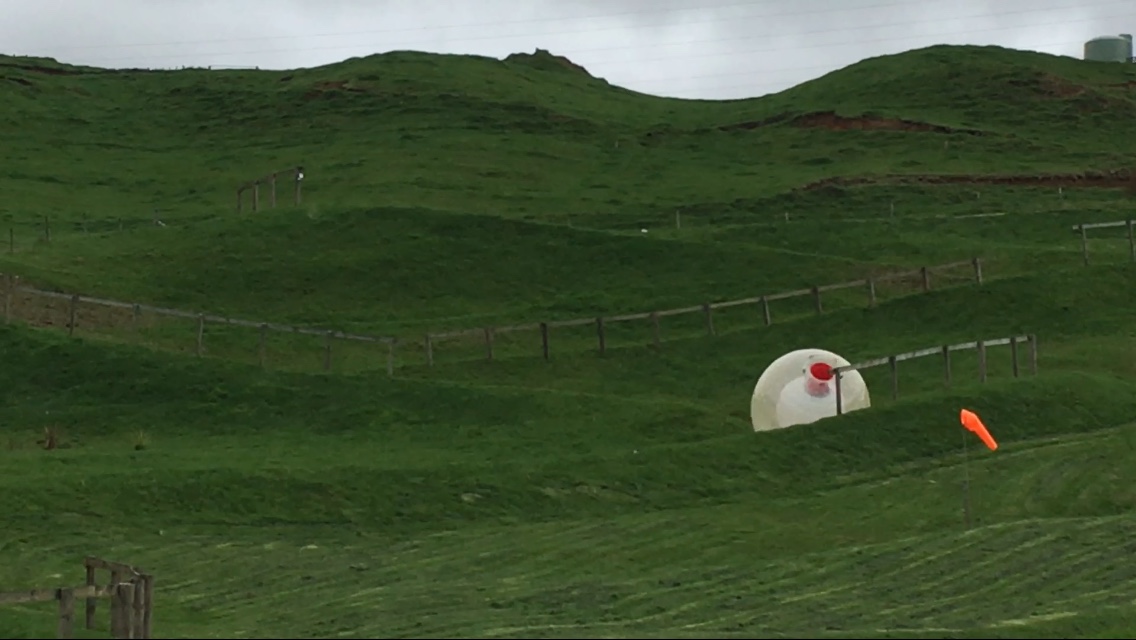
After bungy and swoop, the kids did free fall which is a sky diving type of thing where a giant fan creates a wind column and you float over the fan. We then ventured to the place Zorb was created. We meet the wife of the creator and she explained to us that her husband and a group of his friends wanted to walk on water. They experimented with large inflatable boots which worked great until you fell over. They worked on some other ideas and finally came up with the Zorb. Zorb is a sport in which a participant is “secured” inside (you climb in and they zip the door closed — no seatbelt or harnesses inside) an inner capsule in a large, transparent ball which is then rolled along the ground or down hills. So basically, a Zorb is a large inflated plastic ball, with another ball inside in which you roll down a hill—reaching speeds of up to 50 kilometres per hour! Zorb is very safe, as there is a cushion of air between you and the ground.
After our Zorb adventure we grabbed some lunch where Nico and Luke demolished a Long Dog each (18 in long hot dogs). Our next stop was a mountain bike park. New Zealand has some of the best mountain bike parks in world. Although it was raining hard we were not disappointed biking through some beautiful California Redwoods whose canopy provided a great umbrella. We ended the day with a visit to a local hot springs where we nursed our aches and pains in the rejuvenating water. What a day!

We continued our New Zealand trip the following morning with a 3 hour drive further South to Taupo. Lake Taupo lies in the caldera of the Taupo Volcano and has an area of 240 miles making it the largest lake in New Zealand. We were fortunate enough to stay in a great lodge just above Huka Falls on the Waikato River which drains Lake Taupo. Huka Lodge was once a hunting and fishing lodge and is now a small lodge consisting of 20 cabins.
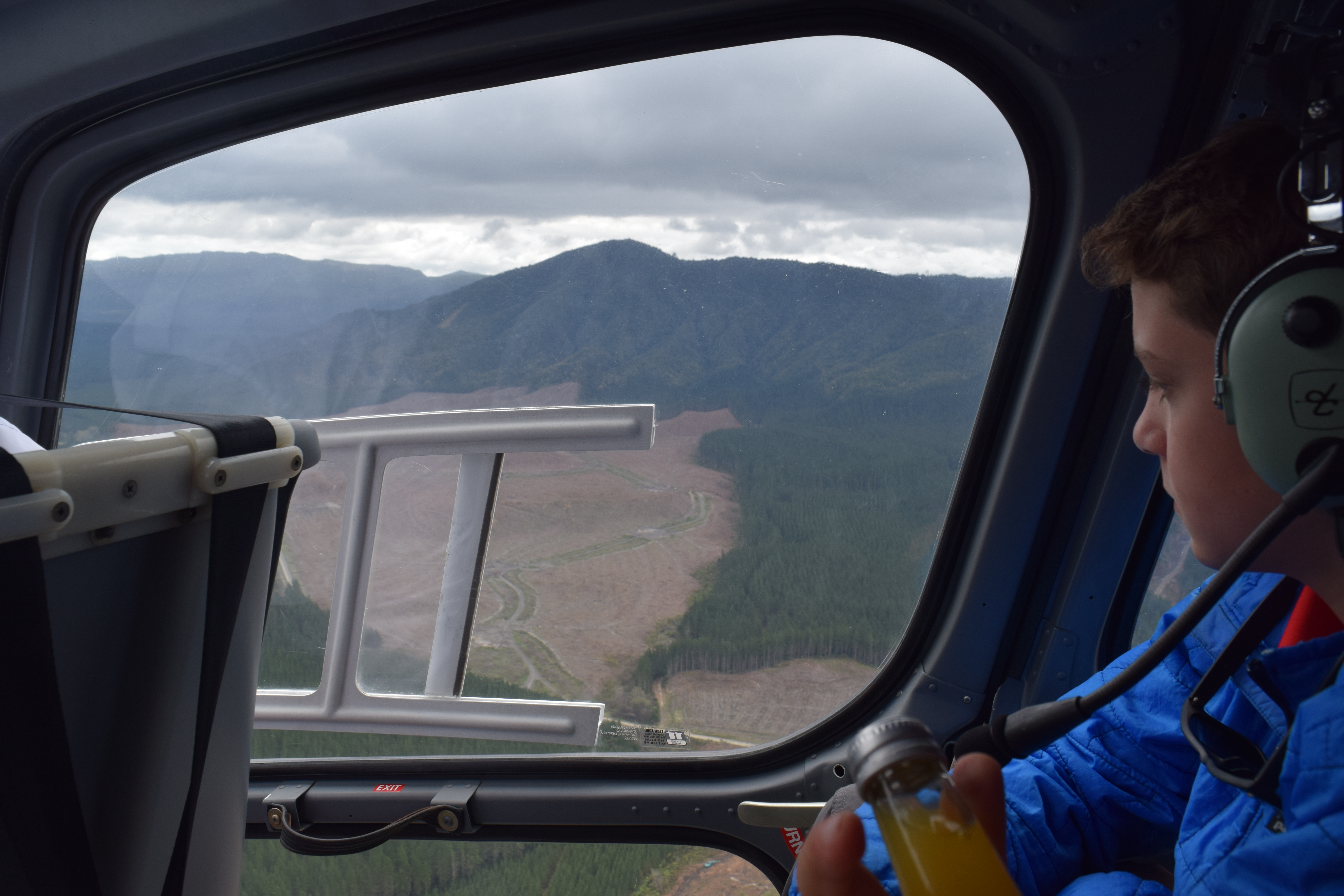
We spent the next day exploring around the lodge and Taupo Lake. The following day we took a trip to White Island which is 30 miles off the East coast of New Zealand in the Bay of Plenty. White Island is New Zealand’s most active cone volcano, and has been built up by continuous volcanic activity over the past 150,000 years. We took a 20 minute helicopter ride to the island and landed on a flat spot on the tiny island. The first thing you notice is the strong odor from the sulfur. We had to wear hard hats as there was an eruption two weeks ago which threw tons of rocks into the air. We are able to walk right to the edge of the caldron where we had to wear gas masks. Our guide told us this was a new edge as the old edge collapsed during the last eruption. I kept thinking that I couldn’t believe that New Zealand allows visitors to this island given the amount of volcanic activity. The guide pointed out that their are probes all over the island that are monitored by scientists and they stop allowing visitors when the pressure builds to an amount that is considered unsafe.


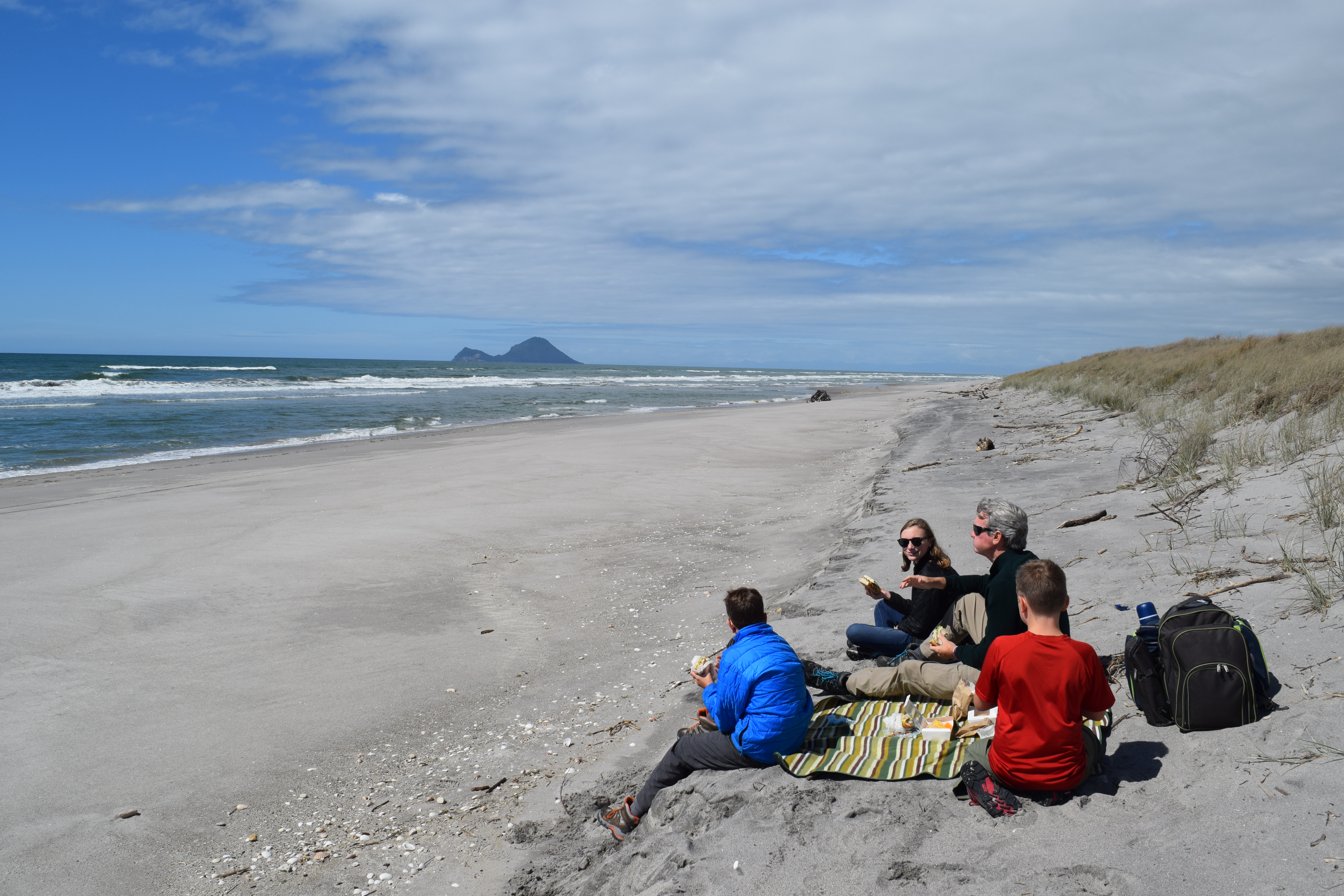
On our way back to the mainland our pilot spotted a clearing on the beach where he landed the helicopter and we had a picnic lunch. It was amazing that we were able to just land on this beautiful stretch of undeveloped beach and have lunch. I also couldn’t believe this land hasn’t been developed. Luke commented that someone could make a sweet links style golf course on the dunes between the ocean and the farm land. Heading back to our lodge we flew over the largest volcano on the North Island as well as a lot of timber farms. Timber is one of the New Zealand’s largest exports
We spent most the next day with kids doing school work, Kristin dealing with securing visas for some of the countries we will visit and I was able to pay some bills, handle some work and deal with some board issues.
Before I close out New Zealand blog, I wanted to note two very interesting policies which I believe could be imported to the USA with positive affects.
First is New Zealand’s energy policy. New Zealand currently produces 85% of its energy from domestic sources. They have an “all of the above” policy that leverages their natural resources and includes; hydro, fossil, geothermal, wind and solar. Currently 80% of their electricity is generated from renewable resources and they are on track to reach 90% by 2020.
New Zealand has a fully competitive generation and retail market (New Zealand’s wind farms compete successfully against other forms of generation without any form of subsidy). Five electricity generators own and operate the vast majority (around 92%) of generation capacity in New Zealand. As the market rules allow for vertical-integration, the generators also dominate the retail market. The deregulation of New Zealand’s electricity market took place over a number of stages between 1987 and 1999. The Ministry of Business, Innovation and Employment develops and implements policy for the electricity sector, particularly relating to the regulatory framework and governance. It also monitors market performance, including competition issues and electricity prices. The Electricity Authority has the role of promoting competition, reliable supply and efficient operation of the electricity market for the long-term benefit of consumers.
The second policy that I think we should implement in the U.S. is New Zealand’s immigration policy. In 1991 New Zealand enacted an immigration policy that ended the preference for migrants from Britain, Europe or Northern America based on their race, and instead classify migrants on their skills, personal qualities, and potential contribution to New Zealand economy and society. This system resembled that of Canada and Australia. Effectively the New Zealand Immigration Service ranks the qualities sought in the migrants and gives them a priority using a points-based scale. Using a points based system, over two-thirds of New Zealand’s admits were based on their ability to contribute to New Zealand’s economy and society.
In contrast to New Zealand, over two-thirds of our legal permanent residents are admitted because they are closely related to a U.S. citizen or permanent resident. Less than fifteen percent were admitted on the basis of their ability to contribute to our economy. Amazingly over one-third of our legal permanent residents are classified as either retired, have no plans to work or are unemployed. Another one-third are children or students and the other third is managerial/professional, sales/office, or trades/laborers. Of those admits over 25 years old only 50% have a high school equivalent or beyond. This does not take into account illegal immigration which would skew these percentages even more.
As you can tell, we really loved our time in New Zealand — from the people and the culture to the landscape and the public policy. New Zealand is the first country we have visited where I could realistically see our family living for an extended period of time.
Greg, This was a very informative blog that reflected both the fun and adventure that you had and the comments on their economic and cultural positions. The photos were really great and I always enjoy sharing your experiences vicariously.
Pops